J. W. Waterhouse’s Depictions Of Circe
John William Waterhouse is a famed Pre-Raphaelite painter. Like the rest of the Brotherhood, he focused on scenes of the Arthurian legends, in the retelling of Tennyson and Keats, and myths from the Classical authors. In his paintings he preferred female subjects, oftentimes featuring a single female figure and conveying the rest of the narrative through her dress, setting, and expression. Waterhouse returned thrice to portraying the sorceress Circe, and by examining this return to the same subject I hope to deduce both how he interpreted her character in comparison to the original sources and how he was able to capture her large legacy and role within the epics through portraiture alone.
|
Abbreviations:
|
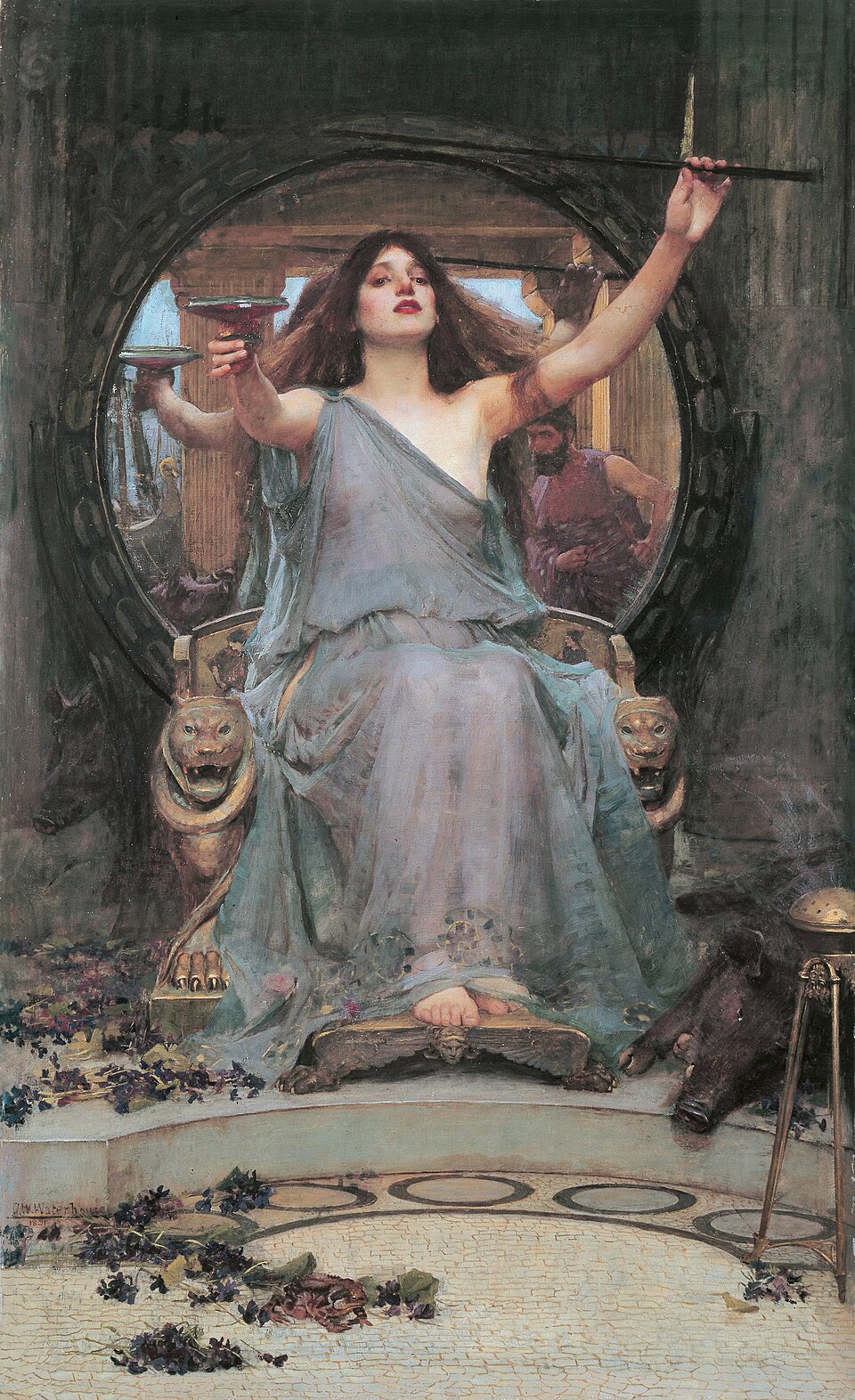
Circe Offering a Cup to Ulysses (1891)
This painting depicts the first meeting of Circe and Odysseus. The Odyssey describes this interaction as Odysseus calling out to Circe from her courtyard and her leading him into her hall in an act of feigned hospitality (Od. 10.311-313). But in the painting, Odysseus enters Circe’s hall by himself. Circe sits on her throne like a marble statue of a deity - which she is - come alive, and in her whole body there is a clear depiction of power and certainty in her plans. And even Odysseus, whom we see reflected in the mirror, looks worried at best, not merely “grieving” as he is said to be by Homer (Od. 10.313). Though this deviates from the chronology and visual appearance of the literary scene, Waterhouse has purposefully done so to capture the themes. Circe here fully exemplifies her epithets of being “queenly” (Od. 10.394) and a “dread god with a singing voice” (Od. 11.7): she is sure of her plan, by now acting in almost a formulaic form, for her schemes have proven to work so many times that she does not even try to hide the fact that she’s a goddess (Od. 10.255). Having deviated in some larger plot depictions, Waterhouse stays true to the original epic in placing a wand into Circe’s hand and placing next to her a pig, one of Odysseus’ transformed crewmen that he had come for.
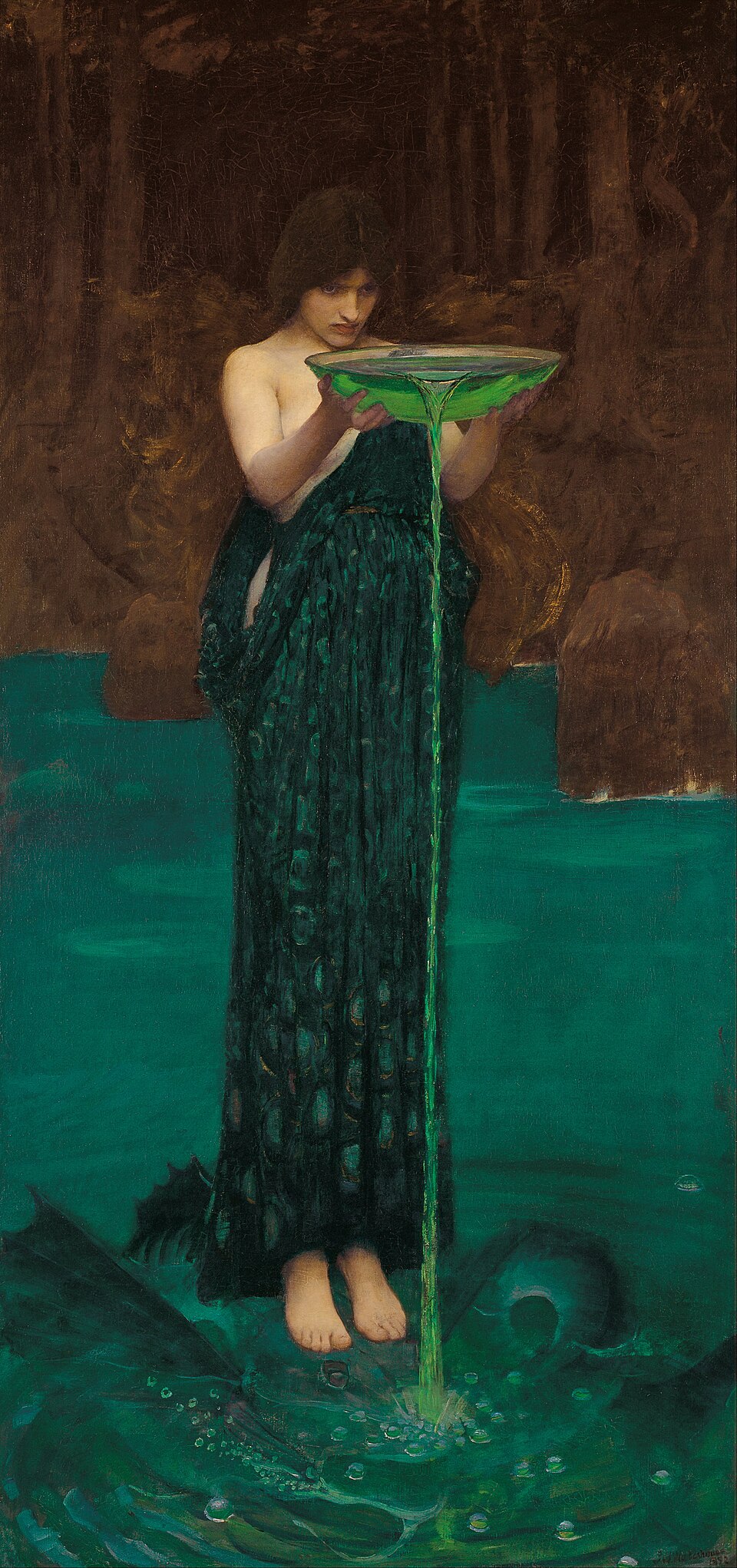
Circe Invidiosa (1892)
Though this scene is based on Ovid’s Metamorphoses rather than the Odyssey, it ties in to the latter, and I would take this opportunity to compare the depiction of Circe in both of these later adaptations to Homer’s. In Book 14, Ovid says that the “Jealous Circe” poured her poison into the pool where Scylla liked to rest and then waited for the metamorphosis to take place (Met. 14.51-58). This depiction of Circe as being a sly trickster both towards Scylla and Glaucon is quite foreign to Homer’s depiction of her, where she always acts in the open. Waterhouse favored Homer’s characterization and depicted Circe as pouring the eerily-green potion right onto Scylla. Also unlike Ovid, who was most interested in the transformation itself, Waterhouse was more interested in the emotions of the protagonist. As per usual, he made one figure be the focal point, and as such, Scylla here is diminished to a mere shadow under Circe’s feet. For this purpose even the many horrifyingly fascinating details of her monstrous form with many heads (Met. 14.59-67, Od. 12.89-92) have been changed to a simpler image of a large fish.
As with the previous painting, in changing some bigger things in order to convey the emotion, Waterhouse has faithfully depicted some smaller details in order to strongly tie the work back to the source. Here, for example, Circe is depicted as wearing the dark blue gown while walking over the waters of the lagoon (Met. 14.45-50), exactly as described by Ovid.
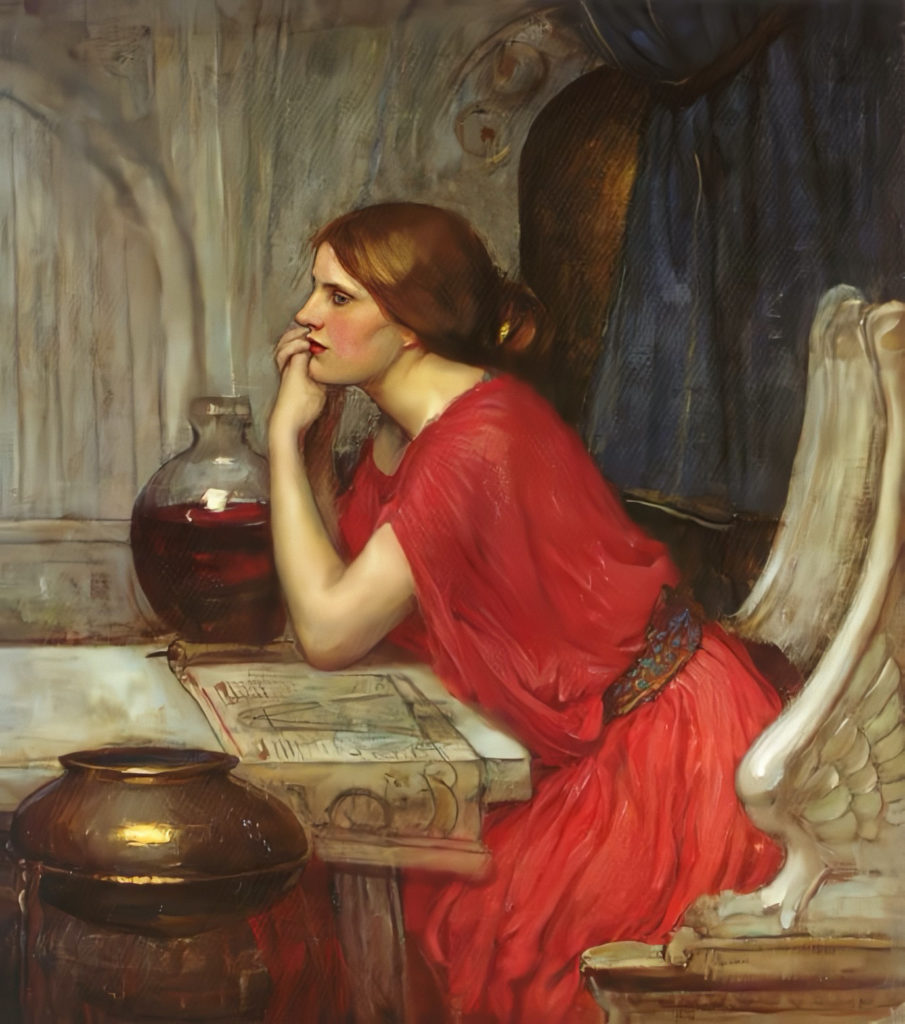
The Sorceress (1911)
Though Waterhouse is known for focusing on the emotions of a character rather than the plot, he tied both of his other paintings to very specific scenes. This painting, however, is different, in that it merely shows Circe at rest, sitting over her books, lost in thought in her “hall …, constructed out of polished stone in a place with a view all around” (Od. 10.210-211). We cannot even tell if this scene takes place before or after her encounter with either Glaucon or Odysseus.
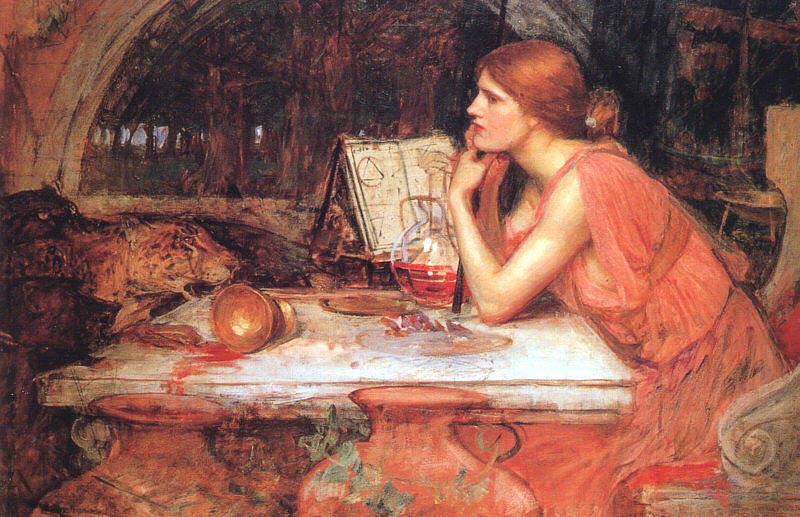
What is very interesting about this painting is not so much the emotions that are portrayed, but rather the way in which they are depicted. While the still nature of a painting is well-suited to the depiction of in-the-moment emotions (something that Waterhouse both exemplifies and counters through the inclusion of several plot elements in one scene), Homer’s oral poetry is better suited to narrating action. As such, the Homeric epics show the characters’ emotions through their actions. For example, Achilleus’ extreme emotions after the death of Patroklos are never named, but rather implied through his random pacing, weeping, and dragging of Hektor’s body behind his chariot (Il. 24.3-18). And with this painting, I think that Waterhouse is returning to this Homeric tradition. Circe’s face has a neutral expression, and her hands show no distinct gesture, yet we can still catch a glimpse of her emotions in the overturned cup on the other end of the table. Considering how calculated and powerful Circe is, it would be strange to think that she would let the cup fall on accident. Is she frustrated over a new potion, or perhaps angry at her loneliness?