Sámi in Alaska
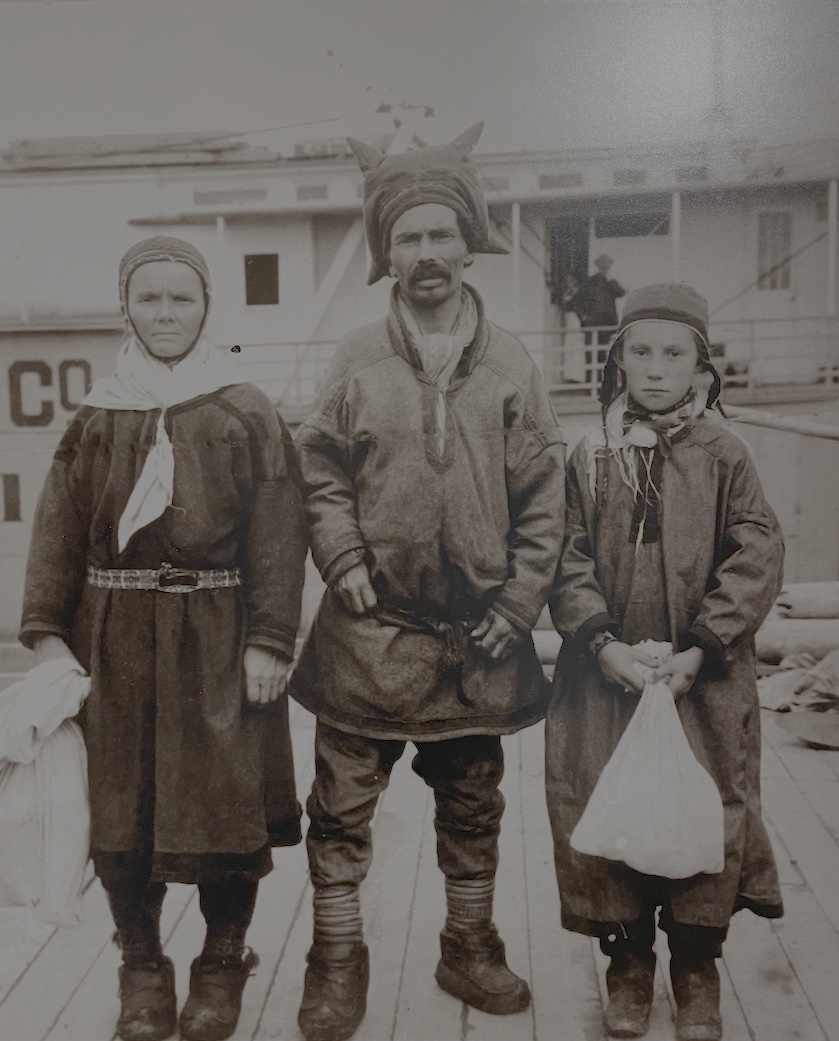
The photo of Marit Persdatter Biti, her husband Anders Johannesen Balto, and their daughter Maria Balto was taken on their arrival in Unalakleet. Maria holds a bag of coins she collected posing for photographs as the group traveled across the United States.
Photo by B. Dobbs
Source: May Balto Huntington
Even though the Reindeer Project was not long-lived, it had passed through several phases, as the people in charge filtered through one after the other, each bringing their own vision to the project. Sheldon Jakson, the founder of this truly unique undertaking, envisioned it as a key element in an effort to civilize the Alaska natives; John Collier, active in the 1930s, took a completely opposite stance, favoriting plurality rather than homogeneity in the American culture, and advocating for the preservation of the indigenous ways; and others still saw the reindeer not as a tool to some end, but as an end in themselves, a resource to be exploited for personal benefit. With all this talk about the reindeer, it is important not to forget the people who were most directly involved with them: the Sami and the Inuit. Though the Sami were originally hired to teach the Inuit and eventually pass on most of the reindeer to them, due to a number of turbulences up until the Lomen Brothers got involved in the industry, the reindeer remained concentrated in their hands, and even in the wake of the political debates between the “white” and “native” advocates, the Sami kept to themselves and continued herding. This aligns with their motives for coming to Alaska - to seek a better and more comfortable life of subsistence herding away from the discrimination and political hardships of Scandinavia, and the US was quite able to provide this opportunity, with the Sami being in a privileged position, much to the envy of their Inuit students, and, as Jakson promised them, they were treated as “whites”. Unfortunately for the Sami, this very perception would lead to their downfall with the passage of the Reindeer Act of 1937. As for the Alaska natives, even though the project repeatedly failed to reach its goals, whatever they may be at a certain point in time, it did somewhat help them to become a firm part of the Alaskan economic and other systems by giving them a means of self-subsistence and a means to participate in the development of Alaska.
The Reindeer Project in Alaska was conceived by Sheldon Jackson, a Presbyterian missionary. Following his strong convictions, he worked with the Bureau of Education under the Organic Act of 1884 to set up mission schools in the newly-acquired Alaskan territory to “civilize” the native population. However, as he was visiting the western villages in 1890 aboard the USS Bear, he observed what he believed to be a crushing famine amongst the native Inuits as a result of the depletion of the local game due to US and Russian over-hunting. Though the fur trade, begun in Alaska in the late 17th century by Russian explorers, did significantly decrease the wildlife populations, the lack of caribou in that year was more likely due to the natural cyclical changes in caribou population. The Inuits were used to such changes, and so they were well-prepared to temporarily change their semi-sedentary lifestyle to nomadism, switch over to other food sources, and to increase trade with the Siberian Chukchi. Jackson, however, knew none of this, and mistakenly overexaggerated the issue. He jumped to action to acquire a sustainable food source for the natives, and his choice fell, quite naturally, on the reindeer. Reindeer had been herded throughout all of the Eurasian North for thousands of years, but not in Alaska, where the caribou (which are of the same species as the reindeer) had never been domesticated. Jackson argued that not only could the reindeer act as a way to save the people from starvation, but they could also pave the way for their integration into American society by turning free roaming hunters and gatherers into more sedentary livestock raisers and entrepreneurs.
Jackson sourced the initial batch of tamed reindeer from across the Bering Strait, and originally he tried to hire some Chukchi herders to go along with these reindeer to act as their caretakers and instructors for the Inuits. However, this did not go as planned, for the four Chukchi herders that he brought proved to be poor teachers and ineffective herders to start with, not to mention the“barbaric” way they conducted themselves. Miner Bruce, the superintendent of the Teller Reindeer Station that they were based in, felt that their presence would only achieve the opposite effect of their “civilizing” goal. Some have tried to explain this attitude and mistreatment of the reindeer by the long history of trade between these two groups, with the Chukchi purposefully abusing the reindeer so as to prevent the Inuits, who previously dependent on them for reindeer products, from gaining this resource for themselves. In any case, after the passage of but a single year it became clear that the Chukchi would have to be sent back to Siberia and new mentors for the Inuit to be found.
In their place, Sheldon decided to hire the Sámi (at the time referred to as Lapplanders). Through newspaper advertisements he had come across William Kjellmann, a Norwegian-born reindeer herder now living in Wisconsin, who had sufficient knowledge about reindeer husbandry and the Norwegian Sámi, thus becoming a key figure in the Reindeer Project. In 1894 Kjellmann traveled to Norway to hire 16 Sámi herders for 3 years in return for fixed wages of $27.50 per month and free provisions and lodging for the duration of their contracts. Following the poor experience with the Chukchi, and having heard that the Christianization process in the North was incomplete, and that some of the Sámi continued to practice their ancestral pagan ways, Jackson made it a point to make sure that his new hirees were Christians, so as to set a good example for the Inuit. As the Sámi traveled by train from New York to San Francisco before heading out by boat to Alaska, people flocked to railroad stations to observe these peculiarly-dressed newcomers. Jackson believed that the Inuit living close to the mission stations would be the best students, since they had already had the most contact with the education program and because the pastors, having better knowledge of their parishioners, could know how to promote reindeer herding amongst them. And their support was needed, since the Inuit still largely preferred their ancestral occupation of hunting and many students found the nomadic way of life reindeer herding required boring, and so they would occasionally run away to the villages to get news and for company. And even though the reindeer were supposed to help the Sámi, because Jackson wanted the herd to grow in number as quickly as possible, the Inuit were forbidden to kill any of the deer, which maddened a number of them. Some, however, became keenly intrigued by the prospect of gaining their own herds and the associated subsidies. According to Jackson’s plan, after two years of training the Inuit could receive two reindeer cows, after two more they would receive five cows, and a year later they would receive ten cows, and they could keep any calves born from them, so that by the end of their five year training period one would end up with a total of 36 reindeer. The initial herd of 171 reindeer brought from Siberia was thus carved out between different reindeer stations to start new herds and to allow for more of the Inuit to come into contact with them. 100 were mover to the mission at Cape Prince of Wales, and another 100 were loaned to Antisarlook, a talented Inuit herder, for five years, with the agreement that he would only need to return the original 100 and could keep all of the claves as the basis for his own herd.
After these initial successes and the observation of the scale of reindeer husbandry in Scandinavia, Jackson’s vision for the Reindeer Project began to shift from simply being small-scale subsistence herding to a larger industry controlled by the Inuit through which they could earn money. As he traveled up the Yukon in 1897 he discovered rich grazing ground and estimated that the gold prospectors who were flooding into the area would create a demand for resources. In mid December of the same year, Kjellmann continued the exploration of the area, this time by means of reindeer sleds. He and two Sámi herders, Mikkel Näkkälä and Per Rist and Kjellmann, traveled a round trip of 1,240 miles, the longest reindeer sled route ever completed. The success of this trip led Jackson to pronounce that reindeer are a superior form of transportation to the dog sleds and pack horses currently in use. It didn’t take long for this claim to be put to the test. That winter, just as Jackson had predicted, the Yukon gold prospectors became stranded without supplies, and he used this as an opportunity to lobby the Congress for support to bring more Sámi and reindeer to Alaska. Jackson hoped to create a permanent Sámi colony that could teach the natives, especially since the contracts of the first 16 herders had ended and many had gone back to Finnmark. The government, on the other hand, was thinking in far shorter terms, and, with limited and distorted information arriving from the frontier, it overestimated the gravity of the situation. Thus, on December 18, 1897 President William McKinley granted $200,000 to Russell Alger,the Secretary of War, for a rescue operation, which would include purchasing the supplies and delivering them by means of reindeer to be hired from Norway. Once again, Kjellmann set out for this purpose and was able to hire 15 Sámi families (43 men, 16 women, and 19 children) as well as 25 Norwegians and 10 Finnish men, as well as 539 tamed reindeer. Because the operation specifically needed trained draft reindeer, Kjellmann had to travel far and wide to get the desired number of them, since only a few could be found in any given herd. Because of the difference in vision for the program, once the new hirees arrived to the United States a disagreement arose between Jackson and the Department of War, since the “emergency” had already passed and the reindeer were no longer needed. But since the contracts had already been signed, it was agreed that the expedition would continue on to Alaska and the deer would be driven to Circle City. However, tragedy struck on the way, as the lichen that had been packed as food for the reindeer had been thrown away by mistake, and with the deer being unable to consume any other type of food, they soon began to starve. The trip was then repeatedly delayed, so once they reached Haines, Alaska, the deer began to drop dead. The Sámi herders made a desperate effort to drive the weakened animals to lichen-rich grazing fields. Despite their best effort, only 114 reindeer were able to make the 1,500 km journey to Circle City in the Yukon Valley. This was a terrible loss - by comparison, only one reindeer had died aboard the ship during their passage over the Atlantic, and even that happened because it got in a fight with another reindeer. The surviving reindeer were divided between the army and the Protestant Episcopal mission on mouth of Tanana River, while many of the Sámi ended their contracts early because there was nothing for them to do. Most of them left the states after 6 months, with only 27 reimagining by the fall of 1989. Most of those that remained became US citizens and found jobs in reindeer transportation for the military and the gold prospectors, or became gold seekers themselves.
In light of all this, the Inuit ownership of reindeer had still not taken off. While the Sámi could work side-by-side with the Americans to sell reindeer for meat and as a means of transportation in the roadless country, to create their own Reindeer Express, or to even be hired as miner or hire miners for their own stakes, the Inuits were far more restricted and disadvantaged. The laws that aimed to benefit them as reindeer herders actually put in a lot more limitations on them in terms of what they could do with their herds, and with the Gold Rush beginning in 1896 they suddenly became swarmed with crowds of gold prospectors settling on their lands and bringing new diseases with them, which created a devastating measles and influenza outbreak amidst the Inuits in 1900. As such, nearly half of the reindeer remained in the hands of the Sámi, and their herds were larger and better-off than those of the Inuits.
In 1905 an independent investigation into the status of the project was launched by Frank Churchill, an Indian agent for the Department of the Interior, who traveled to several reindeer stations. His observations led him to conclude that Jackson’s double role as a general agent for education in Alaska and as a field agent for the Presbyterian Board of Home Missions created a conflict of interests. Thus, he insisted on the secularization of the Reindeer Project and promoted a change of policies to allow only the natives to own reindeer. Churchill criticized Jackson’s idea of a reindeer industry as being naive, and suggested that the project should only focus on providing direct benefits to the Inuits if it was to have any success. This led to the creation of the United States Reindeer Service in 1907 that worked hard to distribute reindeer from the centrally-located missions to the smaller and more distant villages and to engrain reindeer into the native culture through reindeer fairs. These efforts were effective, and by 1915 two thirds of the approximately 70,000 reindeer in Alaska were in native hands, though these herds were still small and disorganized. The downfall of this new project came in the face of a single transaction: in 1914 Nilima, a Sámi herder, sold his herd of 1,200 reindeer to Carl Lomen, a prominent member of the newly-founded city of Nome. The Reindeer Committee was much displeased with this, but Lomen assured the government that he was entering the reindeer industry only to sell to the national market of the “mainland” states, while he would leave the local market to the natives, and thus no conflict of interest would take place. In fact, the Inuits at first came to love him for his generous offers to buy their excess steer for $10 per head and to hire them alongside white herders to tend to his herds. However, given his prominent position and influential family ties, the Lomen Reindeer and Trading Corporation soon came to monopolize the reindeer industry, acquiring a capital stock of $1.5 million within two years. However, not all was going well for the corporation, as their herds soon came out of control. Due to a lack of regulation, rich feeding grounds, and lack of predation, the reindeer exploded in number and became unruly. The smaller Inuit herds would often escape and mingle with Lomen’s herds, and in the confusion it was impossible for the Inuit reindeer to be returned, and their complaints were not investigated. But this increase in number was a problem for the Lomen themselves, as their supply greatly exceeded the demand for reindeer products, and because Alaska was still greatly underdeveloped, increasing their export was unprofitable. In the end, the Lomen Corporation ended up selling their reindeer to the government for just under $500,000. From which point most of the reindeer inexplicably disappeared. It is speculated that the ecosystem of the Svalbard Peninsula had simply reached its carrying capacity, or that the boom in reindeer population had prompted an equal boom in the wolf population, but the most likely explanation lies in the fact that, lacking oversight, they joined their wild caribou brethren.
Bibliography
1. Alaska Chronology 1890-99, BÁIKI: The International Sámi Journal. http://www.saamibaiki.org/contentAlaska/AK1890.html
2. Hofverberg, Elen. “The Teaching Contract that Brought Sami Reindeer to Alaska”, Library of Congress Blogs, 2020. https://blogs.loc.gov/law/2020/02/the-teaching-contract-that-brought-sami-reindeer-to-alaska/
3. Johanna Leinonen and Auvo Kostiainen. “Transnational Finnish Mobilities: Proceedings of FinnForum XI”, Migration Institute of Finland, 2019. https://siirtolaisuusinstituutti.fi/wp-content/uploads/2019/12/t-03-isbn-978-952-7167-61-8-transnational-finnish-mobilities-proceedings-of-finnforum-xi.pdf#page=51
4. NRG Sami Radio. "From Samiland to Alaska", 1993.
5. NRG Sami Radio. "Sammies Over There", 1995.
6. "The Sami Reindeer People of Alaska” catalog. Faith Fjeld and Nathan Muus. Báiki: the International Sami Journal, 2012. https://www.americanswedish.org/sites/default/files/exhibit_downloads/Saami_Exhibit_Catalog.pdf
7. "The Sami who introduced Reindeer Herding to Alaska." Scandinavian Press, vol. 13, no. 1, Winter, 2006, pp. 21. ProQuest, https://www.proquest.com/magazines/sami-who-introduced-reindeer-herding-alaska/docview/218360765/se-2.
8. Vorren, Ørnulv (1994). Saami, reindeer, and gold in Alaska: the emigration of Saami from Norway to Alaska. Prospect Heights, Illinois: Waveland Press. ISBN 9780881337860.
9. North American Sami Reawakening, Sami Cultural Centre of North America. https://www.samiculturalcenter.org/awakening/sami-reawakening-history/