East-West Relations Through the Lens of the Mosaics of the Church of the Nativity
Introduction
The Church of the Nativity in Bethlehem shows a unique example of collaboration between a Byzantine emperor and Frankish leaders within the Crusader Kingdom of Jerusalem. A joint mosaic program between the Byzantine emperor Manuel I Komnenos, the King of Jerusalem Amaulry, and the Latin bishop of Bethlehem Raoul shows the parties’ active attempt at political and religious unity, and thus marks a sort of “Golden Age”, if only this short period of approximately two decades can be termed that, within the relations between these two centers of power. Manuel’s novel strategy for dealing with the Crusaders both allowed for this period of peace and planted the seeds of its demise. He broke his predecessors’ agenda of reconquest of former Byzantine territories and shifted to a Western-like system of vassalage, where local ruler of troublesome frontier countries received large gifts and were allowed to maintain their usual order of business in return for ceremonial subjugation to the Byzantine emperor. The mosaics themselves reflect this contemporary discourse, promoting the reunification of the Eastern and Western Churches while preserving each side’s own beliefs and styles.
The Church of the Nativity
It is generally believed that the original structure of the Church of the Nativity dates back to Emperor Constantine, who had it built after his mother Empress Helen had identified the locus sanctus on her journey through the Holy Land in 326 A.D. It was octagonal in shape, providing a good view of the cave of the Nativity, with a single staircase leading down to it, and a tall nave leading west to a courtyard. In the 6th century the basilica was remodeled by Emperor Justinian, who replaced the eastern octagon with a triconch that allowed for easier access to the cave and was better suited to the liturgical uses of the space. The structural components of the church have not been altered since[1], their apparent age conveying a sense of authority. Thus, by the 12th century not only the holy caves, but also the basilica itself had become revered. Even with the coming of the Crusaders and Bethlehem’s elevation to a bishopric, little changed in the organization of the church itself: the altar was rearranged to serve the Catholic mass, but no other additions seem to have been made[2]. Taking the old age and unchanging appearance of the church together, the large-scale intervention of the mid-12th century would have been sensational. The joint patronage of the Byzantine emperor and the Latin political and religious leaders further increased the symbolic importance of the project.
The mosaics stun with their wealth and detail. All of the compositions have a golden background, and brightly-colored glass tesserae depict people, architectural features, and Classical vegetative designs. According to pilgrims’ accounts, the glittering decoration made the church one of the most beautiful they had seen. Perhaps it is this beauty that contributed to the large number of pilgrims, as evidenced by the presence of every contemporary European and Middle Eastern language in inscriptions left by the pilgrims inside[3].
The mosaics follow a contemporary Middle-Byzantine style and composition. In each scene, the holy characters are emphasized by being made to stand on a higher level than the attendance, with scenes like the Transfiguration having two separate registers. Every scene has a detailed background with architectural features and varied expressions on the faces of the secondary characters. People are shown in dynamic poses, mostly in ¾ profile, with the shapes of the folds of their garments showing a clear awareness of the Classical knowledge of anatomy. While early Christian churches follow the basilica layout, by the 12th century Greek churches had become centralized, arranged around a central dome. Therefore, despite its classic form, the Church of the Nativity challenged the mosaicists with its unusual shape, especially considering that post-iconoclast iconography had become quite formulaic. Nonetheless, they managed to skillfully adapt the typical layout of scenes to this unusual form, as well as to make innovations in Byzantine iconography, prompted by the inflow of Western ideas and the project’s unique purpose.
The focus of the place is naturally on the Virgin Mary and Jesus, leading to the placement of the Platytera in the central apse above the altar and the Nativity itself in the southern apse[4]. Other New Testament scenes were arranged around the transept, most of them now unfortunately gone. In contemporary churches, these scenes would have been centered around the image of the Pantocrator in the central dome. The timber rafters of the basilica, however, made the placement of any image on the ceiling impossible. The image of Christ in His divine glory was ingeniously restored to a central place by moving the scenes of the Ascension and Transfiguration to flank the altar. This gave them visible prominence, and the shapes of the mandorlas recalled the round composition of the dome. The western end of the nave deviates from the Byzantine tradition by displaying a clearly Western Tree of Jesse. This symbolic representation of Christ’s genealogy originated in the late 11th century and was popularized in England and France in the second half of the 12th century.
The clerestory of the nave is divided into three registers. The lowest one features the portraits of Christ’s earthly ancestors, all in varied poses, their names provided in Latin. The top register consists of a procession of angels, 8 feet in height, walking as if alongside the entering pilgrims towards the holy cave. The middle register is unique amongst all known iconography in its depiction of the church councils. The south wall is adorned with representations of the seven ecumenical councils, while the northern one features the local Syro-Palestinian provincial councils. The councils are represented as churches on the southern wall and as sets of double arches on the northern, with ornamental vases and floral motifs between them. Inside the architectural elements, black text upon a silver or golden background speaks of the resolution of that council, the number of clergy present at it, and the heretics anathematised, with the name of the city where the council took place written above. Such a depiction is quite unusual, as councils are usually depicted figurally, with the bishops and heretics portrayed seated together mid-argument. In the case of books, the details that cannot be recorded pictorially could be provided as text, but text and image were never mixed. The Church of the Nativity uniquely integrates these two media, with the image becoming a symbolic housing for the text.
While the mosaics follow a generally Byzantine format and style, at least some of the artists working on them seem to have been locals. On the northern wall of the narthex, at the feet of the angel above the Council of Antioch is a golden bilingual inscription commemorating “Basilius pictor” in Latin and Syriac, indicating that at least one of the sub-leaders of the project was a local Syrian. The style of the mosaics is also indicative of this. Little work has unfortunately been done to document the intricacies of local styles, with all of them being broadly categorized as Byzantine or “Crusader” art, but some aspects of the decorative elements of these mosaics seem to be clearly local. For one thing, they implement tesserae made of mother-of-pearl, a material not found used elsewhere. The vases with uniquely-arranged fantastic plants and scrolls coming out of them, especially lively on the northern wall, also seem to bear a local flavor. Hunt[5] compares their designs to the mosaics found in earlier Muslim monumental buildings, such as the Dome of the Rock, al-Aqsa, and the Great Mosque of Damascus, all of which would have also relied on local artisans. For example, she points out that the wing-like design found near the depiction of the Council of Sardica is likely borrowed from Sasanian royal imagery.
A bilingual inscription in the apse dates the completion of the project to 1169. Around the same time, columns in the double-rowed arcades along the nave were being adorned with encaustic icons of saints. Based on stylistic evidence, Folda[6] dates the individual icons’ completion as ranging between 1130s and Bethlehem’s recapture by Saladin in 1187. Though about half of them were completed during or immediately after the mosaic program, it is generally accepted that they were not part of the project, rather being individual votive offerings commissioned by the pilgrims and parishioners. Graffiti on the bases of the same columns have been found in every contemporary European and Middle-Eastern language, indicating a very diverse community[7]. The icons support such a conclusion, as they display a wide range of regionally-venerated saints, from Egyptian ascetics like Saint Anthony the Great to Saint Olaf of Norway. Despite their varied provenance, all of the figures are represented in the same manner, standing frontally in a Byzantine iconographic style, upon a blue background and red frame.
The conception of the mosaics
The relationship between the Crusaders and the Byzantine Empire had always been complicated, wavering between alliances and deep mistrust. When Alexius Komnenus asked Pope Urban for Western troops in his attempt to reconquer lost Byzantine territories in the East, he was shocked by the large number of disorganized and self-minded soldiers that turned up. Worse yet, these armies refused to honor the original agreement of returning all captured land to the emperor, instead setting up states of their own and even attacking the Empire itself. To the Byzantines, the Crusaders were “mercenaries-gone-rogue”[8]. Both Alexios and John tried to fix this freak phenomenon, as they saw it, through alternating diplomacy and warfare, but both approaches ultimately failed. This can be attributed to the fact that the Latins did not want to have any dealings with the “schismatic Greeks”[9], especially with the growing sense that the Byzantines were only hindering the Crusades rather than sincerely aiding them. The whole concept of the Crusades was also fundamentally different for the two sides, leading to them talking past each-other.
When the troops of the Second Crusade began arriving at the Bosphorus in 1147, the Byzantine perspective changed. It became clear that the “freak phenomenon” had become a new reality. So Manuel employed a new strategy to bring the unruly frontier lands under Byzantine control. Instead of full domination, he allowed local leaders to remain in power and to maintain their customs, instead focusing on the more symbolic acceptance of Byzantine power in a system reminiscent of Western feudalism. This became the model for all of his international relations, not just with the Crusader States, but also with Sultan of Rûm Kilij Arslan II in 1161 and the Serbian prince Desa in 1172. The ceremony became the testimony of loyalty, a ready formula demanded by the emperor to his new subjects. To prevent any resentment or spite from the newly subjugated leaders, lavish gifts were bestowed on them. Even in the most humiliating instance, when Raymond of Antioch was forced to abase himself before the tomb of Emperor John II for attacking Manuel’s army as it retreated in 1143, he left Constantinople with much Byzantine gold[10].
The strategy proved to be successful, and in 1159 it permitted Manuel to regain control over Antioch. The vassalage was secured through his ceremonial entry into the city before both the Count of Antioch and the King of Jerusalem. He was able to solidify his claims over Antioch further through a marriage to Maria in 1161, but that choice enraged both King Baldwin III and Count Raymond II of Tripoli, whose daughter Melisande he had originally wooed. Though the past mistrusts over the Second Crusade were still present, it is likely that the decision to bestow upon Bethlehem a new artistic program was mainly prompted by grievances closer at hand. The Second Crusade, and the even more distant Schism served as the formal subjects of discussion for the mosaics, while the act of their execution was prompted by more proximal events. Manuel might have also hoped that King Baldwin III would become almost a representative for him in the Crusader States, keeping them in line and ensuring that his interests remained represented. Moving forward, the alliance would only strengthen under Baldwin’s brother Amaulry, as he would marry Manuel’s grand-niece Maria in 1167 and be the first Frankish king to visit Constantinople to enter into a formal military alliance in 1171. It would, unfortunately, be the same alliance that doomed the relationship, as the resulting joint campaign against Egypt would prove to be a complete disaster, with both sides blaming the other for the failure and the Latins proclaiming that the Byzantines had sabotaged the effort the same way that they had sabotaged the Second Crusade.
Religious and political discourse
The bilingual apse mosaic provides invaluable details as to the mosaic’s patronage. Only the Latin half and the snippets from the ends of the Greek lines survive to our days, but the careful descriptions of travelers such as Francesco Quaremius allow for their reconstruction[11]. The Latin part reads: “King Amalricus, guardian of virtue, generous friend, comrade of honour and impiety's foe, patron of justice and piety, avenger of wrong, was fifth on the throne, and over the Greeks ruled Emmanuel, the generous donor and pious ruler, and as president and teacher of the church here lived Ralph the benignant, worthy of the bishop's throne, when the hand of Ephraim, they say, brought the present work to completion”. Interestingly enough, the Greek inscription to its left fully reverses the order of the names, declaring that “The present work was finished by the hand of Ephraim the monk, painter and mosaicist, in the reign of the great emperor Manuel Porphyrogenitus Komnenos and in the days of the great king of Jerusalem our Lord Ammori and of the most holy bishop of holy Bethlehem Lord Raoul, in the year 6677, second of the indiction”[12]. Considering that the Creation was believed to have taken place in 5508 B.C., this places the completion of the mosaics at 1169 A.D.
Even though the project was a sign of amicability, it did not enforce unity between the nations[13]. The different inscriptions catered to their respective audiences without assuming a mixing-pot with a single universal ideology, language, or any other shared characteristic, making it natural to invert the order in which their leaders are mentioned. Even though the Frankish settlers and the local Christians, largely Byzantine-leaning Melkites or Monophysites, lived in close proximity, their relationship can be best described by the term of “rough tolerance”, where different customs and religious practices were, for the most part, tolerated, but neither of the various groups ever assimilated to merge with the other[14]. Interestingly, both inscriptions also mention Ephraim, a Greek or Syrian monk and the designer of the mosaics, suggesting a strong local presence and expression within the imperial project.
Given Manuel’s foreign policy at the time, I would conclude that he would be the initiator of the project. The accusations of Byzantine sabotage of the Second Crusade and the recent insult to Baldwin through the refusal of his proposed bride were both issues needing to be patched up. And considering the ceremonial acceptance that Manuel had secured at Antioch, it was now high time to reward his new “vassals”. While the other frontier territories were governed by lesser rulers, the Second Crusade was led by kings, and the Crusader States had firmly established themselves as kingdoms. Manuel’s gift, therefore, had to be one that would not infringe upon the Frankish sovereignty. A gift can also be perceived as an offense if it is given in a condescending manner, from a higher-up to someone who is forced to accept a lower position by accepting a gift. The idea of a joint project mitigated some of these concerns. The Church of the Nativity was also a carefully-chosen site, as it continued to be very significant, but was no longer directly attached to the crown. It hosted the coronations of the first two kings of Jerusalem, but the coronation site was moved to the Church of the Anastasis (or, in the Latin manner, of the Holy Sepulcher) with Fulk’s coronation there in 1131. On the other hand, to the Byzantines themselves the church may have been a physical manifestation of their past rule over the entire Eastern Mediterranean, acknowledging the sense of duty to restore these territories. In Emperor Alexios’ 1110 agreement with Pisa, one of the conditions was to not interfere with any Byzantine lands or lands that were not yet under its control, but which the Empire had interests in, which included everything up to Alexandria, showing the continued sense of entitlement to these former territories.
A central and unique part of the mosaics is the church council cycle, which must have been important for both sides. Even though the Orthodox and Catholic churches had already officially parted ways in the Great Schism of 1054, the event was not yet known by that name, nor was it perceived as a point of no return. Such sentiments would be solidified by the sack of Constantinople in 1204 during the Fourth Crusade, but before then both sides made many attempts at reconciliation[15]. The depictions of the church councils would have served to stress the Orthodox and Catholics' shared history and dogma through the representation of the mutually accepted seven ecumenical councils and the local Syro-Palestinian councils that worked to enforce their rulings. But wittily, the same depictions could have a second function of denouncing Catholicism in favor of the Orthodox dogma. The disagreements that had built up leading to the Great Schism can mostly be traced back to the question of papal authority and infallibility. By choosing to depict the councils, these mosaics stress the Orthodox view that all people, even the patriarchs, are subject to error, and thus no decision of doctrine can be made by any one person, but must be a joint consensus of the council[16]. Moreover, by depicting the councils aniconically, they present the theological claim that the decisions of the councils are not arbitrarily decided by the majority vote, but are rather the site of divinely-guided ruling. The church-shaped housings for the text brings it out of the human context and brings it closer to the “purest”, divine sphere of being. The repeated imagery of the gospel book represents Christ’s personal presence and sanction.
The details of the councils further point out the specific differences in dogma. The First Council of Constantinople omits the Catholic Filioque, showing a clear Orthodox bias in the composition of the text. The trend, however, is abruptly broken with the Second Council of Nicea, the last of the seven ecumenical councils, which is written in Latin, not Greek. Kühnel[17] provides a fascinating explanation for this: that the artists executing the mosaics had exemplars of text in Greek only for the first six councils, and to complete the remaining one they simply chose to borrow an available Latin exemplar. He notes that most Greek manuscripts of the time lack a synopsis of the Second Council of Nicea, and those that do seem to be later additions. Such an explanation challenges the notion of the top-down insistence on personal correctness and allows for the recognition of much more close-knit and pragmatic relations between the diverse inhabitants of the Crusader States.
As the encaustic icons of the columns show, both Western Catholics and Eastern Orthodox parishioners were present at the basilica simultaneously, and apparently they did not mind sharing the liturgical space nor placing their patron saints right alongside each-other. Even though all of the saints canonized before the Schism are shared by both churches, their worship carries a localized pattern, with the choice of saint thus reflecting the origin of the commissioner. Depicting a revered saint, often alongside an inscribed prayer or miniature depiction of the commissioners themselves, was a way to make one’s prayer permanent, and to strengthen it by physically attaching it to the holy place. Many of these icons are labeled both in Greek and Latin, which seems to suggest a recognition of the shared veneration, or an invitation to such in the case of the lesser-known saints. For example, Saint Catald, the 7th-century Bishop of Taranto, a coastal Apulian town, gained intense local veneration after his tomb was rediscovered in 1071, but remained largely unknown elsewhere, including in his native Ireland[18]. The bilingual inscription left by the Norman-Apulian pilgrim who commissioned the icon was likely meant to introduce an unknown figure to the larger community.
The Latin clergy also seem to have been happy to receive the new mosaic project, and thus happy to contribute to it. Bethlehem became a bishopric in 1110, which caused much controversy and power struggle amidst the Latin clergy. Ascalon had been the ancient bishopric, but it was captured by the Crusaders only in 1153. By that time, Bethlehem had already become an elevated center, and thus the then-present Bishop of Bethlehem Gerald opposed the appointment of a new bishop to Ascalon, laying claims over it. He appealed to the Pope, who ruled in his favor and the old and new bishoprics were merged into one under the head of Bethlehem sometime between 1163 and 1168. The mosaics project must have also added to Bethlehem’s claim to power, with the new Bishop Ralph’s name (1156-1174) being permanently attached to the episcopal seat alongside the names of his powerful “supporters”. Here again we see an example of the tolerance that existed at the time within the Kingdom of Jerusalem. All 12th century Melkite episcopal lists continued to list Ascalon as a bishopric and to skip over Bethlehem, keeping to the ancient conventions rather than adopting the Catholic rearrangement[19]. This official lack of recognition, however, did not hinder the project, indicating each side’s willingness to allow the other to carry on with their own conventions as long as they did not interfere with overlapping areas of interest.
The main thing that the Frankish settlers gained from their collaboration with Manuel was the recognition of their claims to the land. The dispute that had plagued them since the beginning was being ruled in their favor, as they were now bound only by words of promises without having to give up anything materially. The mosaics reinforced this claim. The most obviously Western element of them, the Tree of Jesse, is closely linked to the Western aristocracy’s growing interest in genealogies as justification of their claims to power and territories. Amalric was only the fifth king of Jerusalem, and though he still had precedent to support his kingship, he strengthened his claims by proclaiming the new settlers of the land, the former Crusaders, to be good protectors of the holy sites. The Tree of Jesse here, for example, is actually truncated and starts not with Jesse, but with his descendant Abraham. Abraham appears again in the central apse, flanking the Virgin and Christ alongside King David. Such a focus on Abraham may have arisen from the proximity of the Castellion Sancti Abraham, located just 20 kilometers to the north of Bethlehem. There, the Crusaders believed to have found the tombs of the three patriarchs Abraham, Isaac, and Jacob, and their wives, Sarah, Rebekah, and Leah. Their tombs were refurbished and Hebron became a prominent pilgrimage site[20]. This strengthened the Crusaders’ self-perception as the re-discoverers of the holy sites and objects, as well as the protectors of them from the infidels (a term that was loose and could at times be applied to any group of people in the context of the porous delineations between any religious, ethnic, or cultural group in 12th-century Levant), a position that now seemed to be recognized even by the Byzantines.
Conclusion
The interdenominational dialogue between the two main powers of Christendom, the Roman Catholics and the Byzantine Orthodox, has largely been defined by polemical disputes and the desire of each side to settle things on its own terms. Despite their tensions and shortcomings, the early Crusader period, until 1171, may have been the closest point in their relationship until the Early Modern period. This was a time of cultural exchange. Later, at the start of the Renaissance, the Italian artists would borrow heavily from the Hellenic artistic tradition, though they only borrowed the styles, subordinating them to their own ideologies. But for the time being the exchange went beyond the material things and through the mutual exchange a new culture was arising. Through the establishment of reliance on the other, holy spaces were able to be shared. Active work was carried out towards ecclesiastical unity, and though these efforts were to prove unfruitful, the situation did not appear so bleak at the time. Of course, people rarely cared to look beyond apparent differences and tended to perceive their own circle to be superior. This was especially the case for the Westerners. The Frankish chroniclers did not distinguish between the many fine differences separating the local populace, while the coming pilgrims saw pride in finding references to their own county or family that had been left as graffiti in visible locations, priding themselves above both locals and other “Europeans”. But on the highest levels, both the Crusader Jerusalem and Constantinople were working towards cooperation. Both had representatives of each-other at court through diplomatic marriages, who acted as bridges to the other culture and religion, thus counter-balancing the bottom-up enmity between groups through top-down patronage. At this time things were going relatively well for both. Neither was in a desperate situation, unlike, say, during the Council of Florence (1431-1449), so no forced decisions were being made, allowing for a fairer discourse. The interactions were instead deeply personal, leading to a sense of respect to remain in place even when full agreement on issues could not be reached.
The main obstacles to this process of integration were perhaps the desire by both sides to lay full claims to the other and establish their own rightness, and the rising levels of distrust. The Byzantines had grown weary of all Normans due to their numerous raids. The Holy Roman Empire wished to be seen as the sole legitimate heir to the Roman Empire, a claim that the Byzantines contested. Geanakoplos[21] suggests that it is this very issue that marks the beginning of the East-West rift. The mutual claims to the Holy Lands, particularly the Principality of Antioch, also led to much open strife. With both sides strongly believing in their own rightness, they occasionally talked past each-other and saw what they wanted to see, leading to further misunderstandings. Manuel saw King Amalric’s visit to Constantinople as an admission of vassalage, while the failure of the Third Crusade and the joint expedition to Egypt led to grave suspicions of Byzantine malice.
The growing resentment reached a point of no return with the capture of Constantinople in 1204. Until that point the Schism of 1054 appeared as a temporary rift, as something that could be mended if only one or both of the sides relinquished their stubbornness and resentment. However, after the West showed themselves as being predatory, the possibility for reconciliation was severed, it appears forever.
Bibliography
1. Bacci, Michele, et al. "Historical and Archaeological Analysis of the Church of the Nativity." Journal of Cultural Heritage, vol. 13, no. 4, Dec. 2012. https://www.sciencedirect.com/science/article/pii/S1296207412001653.
2. Charanis, Peter. "Aims of the Medieval Crusades and How They Were Viewed by Byzantium." Church History, vol. 21, no. 2, 1952, pp. 123–134. JSTOR, https://doi.org/10.2307/3161078.
3. Estelle Ingrand-Varenne. Chiselled in rock, printed on paper: Francesco Quaresmio and the epigraphy of the Holy Land. Mediterranean Historical Review, 2023, Pilgrim Knowledge: Travel and Empiricism in the Early Modern Holy Land, 38 (2), pp.273-290. https://shs.hal.science/halshs-04343027/document.
4. Fishhof, Gil. Shaping Identities in a Holy Land: Crusader Art in the Latin Kingdom of Jerusalem: Patrons and Viewers. Routledge, 2024. [Link].
5. Folda, Jaroslav. "Twelfth-Century Pilgrimage Art in Bethlehem and Jerusalem: Points of Contact Between Europe and the Crusader Kingdom." Romanesque and the Mediterranean, vol. 2015, pp. 1–14. British Archaeological Association, 2015. [Link].
6. Geanakoplos, Deno John. Byzantine East & Latin West: Two Worlds of Christendom in Middle Ages and Renaissance. Harper Torchbooks, 1966.
7. Hunt, Lucy-Anne. “Art and Colonialism: The Mosaics of the Church of the Nativity in Bethlehem (1169) and the Problem of ‘Crusader’ Art.” Dumbarton Oaks Papers, vol. 45, Dumbarton Oaks Research Library and Collection, 1991, pp. 69–85. Academia.edu, [Link].
8. Jotischky, Andrew. "Manuel Comnenus and the Reunion of the Churches: The Evidence of the Conciliar Mosaics in the Church of the Nativity in Bethlehem." Levant, vol. 26, 1994, pp. 207–225. ISSN 0075-8914.
9. Juhász, Emérico Vicente. Pinturas y grafitos. Basílica de la Natividad en Belén. Studium Biblicum Franciscanum, Edizioni Terra Santa, 2021.
10. Kühnel, Bianca and Gustav. The Church of the Nativity in Bethlehem: The Crusader Lining of an Early Christian Basilica. Verlag Schnell & Steiner GmbH, 2019.
11. MacEvitt, Christopher. The Crusades and the Christian World of the East: Rough Tolerance. University of Pennsylvania Press, 2008. JSTOR, http://www.jstor.org/stable/j.ctt3fh6pf.
12. Magdalino, Paul. The Empire of Manuel I Komnenos, 1143-1180. Cambridge University Press, 1993.
Images (Captured on August 4, 2023 by Vlad Carpenco)
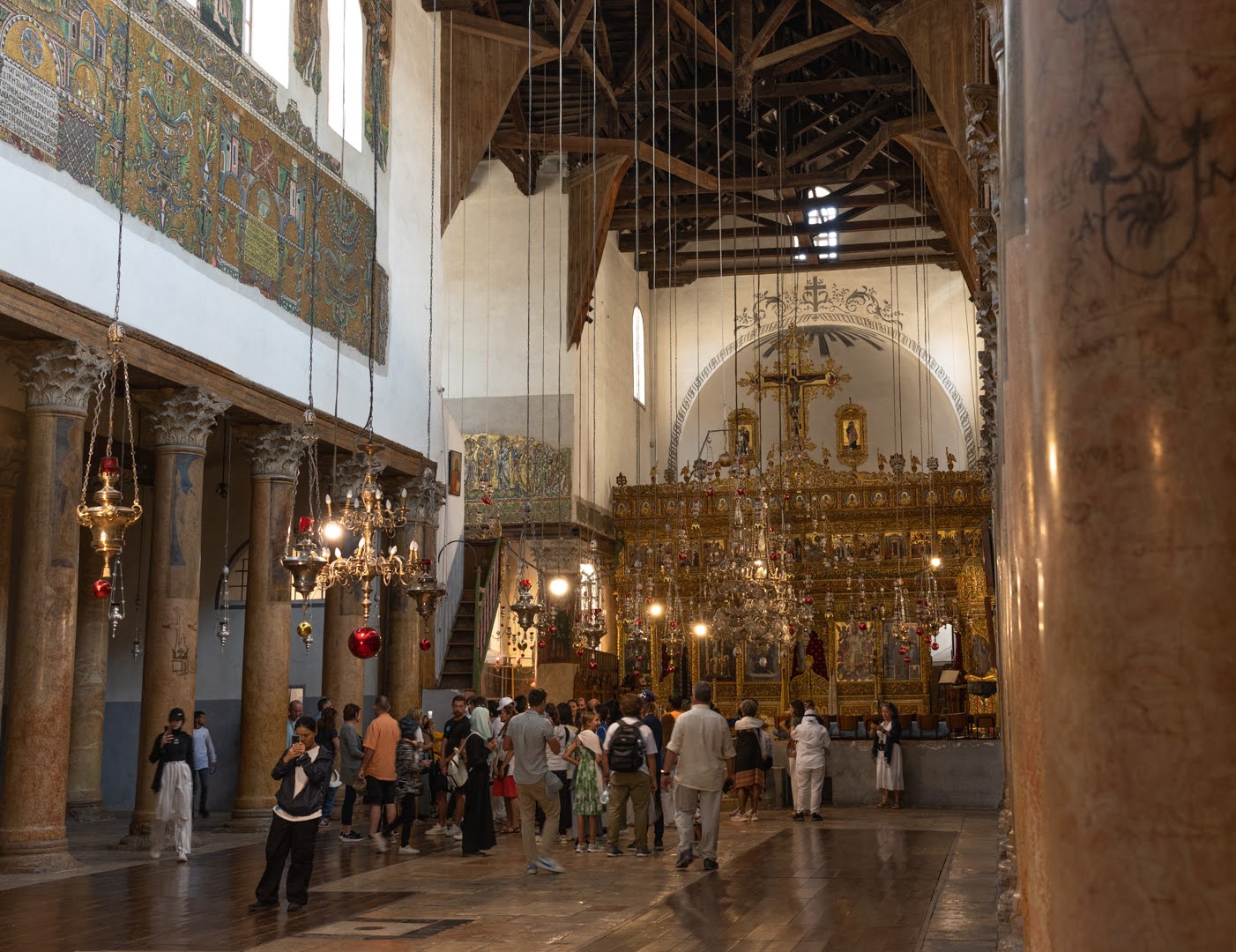
Image 1: View towards the altar from the southern aisle. Note the provincial councils on the northern wall, the procession of angels between the windows, the Apparition to Thomas in the transept, the large size of the encaustic icons on the columns, and the Crusader heraldic image on the column in the foreground.
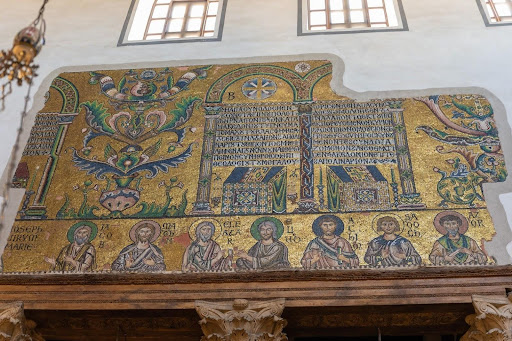
Image 2: First council of Constantinople on the southern wall of the nave. Note that the text of the council is written in Greek, but the names of Christ’s ancestors are written in Latin.
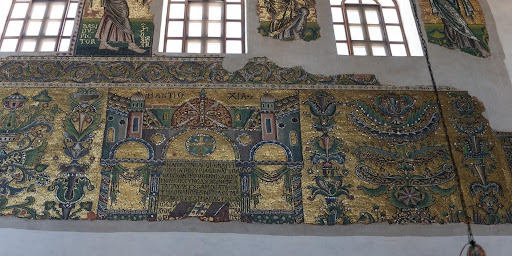
Image 3: The provincial council of Antioch upon the northern wall. Note the “Basilius pictor” written in both Latin and Syriac at the feet of the angel on the left. Also note the detailed and lively floral patterns on either side of the council and their incorporation of Classical and local elements, such as the wing motif on the left that has been compared to similar depictions within the Dome of the Rock.