A Watercolor Recreation of the Ludwig Psalter, Folio 3R
Also published in Dies Legibiles, An Undergraduate Journal of Medieval Studies, Fifth Edition (2024–25):
A WATERCOLOR RECREATION OF THE LUDWIG PSALTER, FOLIO 3R
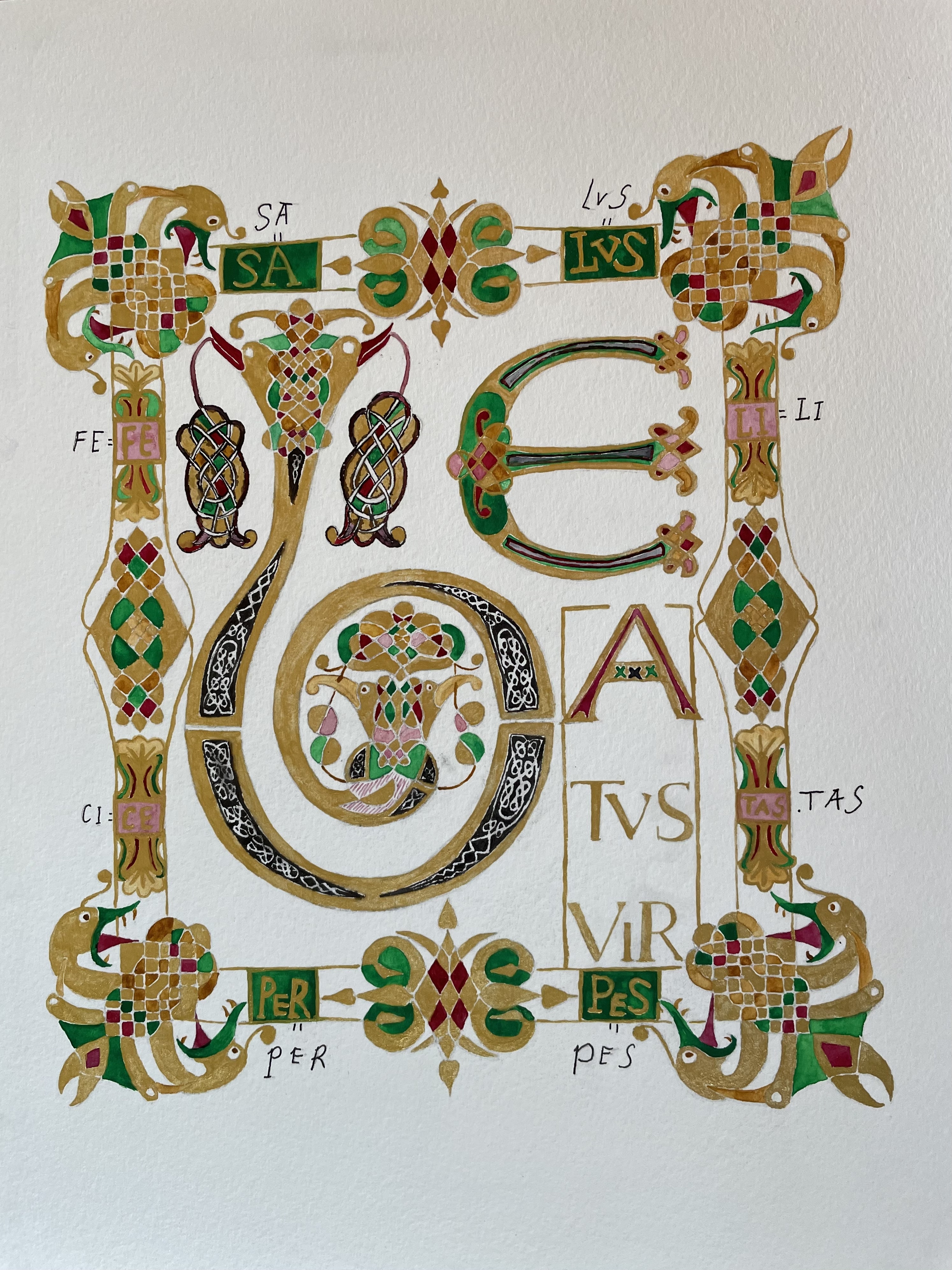
This is a watercolor recreation of fol. 3r of the Ludwig Psalter, a psalter made between 825 and 850 at the Abbey of Saint Bertin for a certain King Louis, most commonly identified with Louis II, grandson of Charlemagne and the first ruler of East Francia. I chose to recreate a leaf of this manuscript to explore and commemorate two major points: the interconnectedness of different countries and the flow of ideas and artistic styles during the Early Middle Ages, and the central role of the psalter in the Medieval court.
Looking at this full-page illumination of the first words of the Psalms, one may be struck by the distinctly Insular design of the page with its complex interlacing patterns and characteristic birds’ and dragons’ heads in the corners. These foreign designs continue throughout the whole manuscript alongside the distinctly Frankish element of the Carolingian minuscule. This synthesis of the Insular and Frankish artistic traditions is the direct result of the process begun by Louis’ grandfather Charlemagne, known as the Carolingian Renaissance, which aimed to revive education and high Christian morals amongst the people. Great thinkers, clergymen and artists were drawn from afar to Charlemagne’s court, including the Irish monks who had until then been the main preservers of Latin and spreaders of Christianity. The history of the Early Middle Ages is often hard to study because of the lack of surviving primary sources, but thanks to the revived interest in writing we have plenty of manuscripts surviving from the Carolingian empire. Yet this bounty of Latin documents has led many historians to overlook other important sources of information, namely archaeological findings, vernacular literature, liturgical manuscripts, and the visual arts (Goldberg 1998)[2]. It is these last two that I focus on in this project.
During the Early Middle Ages kings would often look towards their Old Testament counterparts as exemplars, and regularly reading commentaries on these Biblical stories became popular amongst Charlemagne’s descendants. But of the Old Testament books, the Psalter was of an even greater importance than the histories. It enjoyed a widespread standing: while the Books of Hours dominated the High Middle Ages, the Early period was a “psalmodic culture”, with everyone, from the clergy to the laity, being encouraged to use the Psalter as the basis of their personal prayer. The text of the psalms was often used to teach students to read, with “psalteratus” being the term to denote someone who was literate. And for the kings, the words of King David were the model for achieving and enacting piety, the quality valued in, and eventually expected to be seen in, legitimate kings. It is hence of no wonder that such lavish decorations were bestowed on the Psalters. Consequently, these rich manuscripts became a form of diplomatic gift to ecclesiastical institutions that solidified the monarch’s ties to God and the Church while also showcasing his wealth (Adamska 2013)[1]. It also played into the Carolingian ideal of standardizing the liturgy and correcting the corrupted Latin by spreading new manuscripts with corrected spellings and a clear, legible text written in the specially-developed Carolingian miniscule.
The Psalter, therefore, can be seen as a symbol for King Louis’ rule. Even though he had been termed “the German” since the 18th century, he himself did not perceive himself as being anything but a ruler of Eastern Francia, an heir to Charlemagne. And he ruled not over Germans, but over a loose collection of various peoples, including the never-before united Francs and Slavs, and the synthesis of different artistic styles in the Ludwig Psalter stands as a good emblem for this diversity. The care with which it was made shows him as an heir not only to Charlemagne’s lands, but also to his ideals. And the vibrant miniatures found on each page would have served as a contemporary sign of his power as the Psalter would be read aloud to him in the presence of his court.
Since my goal with this project was to explore how the visual arts fit into and inform their historical and cultural context, I made the choice to use modern materials rather than historically-accurate dyes and inks in order to concentrate on the design rather than the production techniques.
Works Cited
1. Adamska, Anna. A Book in All Royal Hands. How Medieval Rulers Read the Psalter. Polish Libraries, Vol. 1, pp. 186-209. 2013. Bibliotheca Narodowa.
2. Goldberg, Eric Joseph. Creating a Medieval Kingdom: Carolingian Kingship, Court Culture, and Aristocratic Society Under Louis of East Francia (840-876). Order No. 9840394 University of Virginia, 1998 United States. VirginiaProQuest. Accessed 15 March 2024.
3. Staatsbibliothek zu Berlin - Preußischer Kulturbesitz, Ludwigspsalter. Accessed 15 March 2024. https://doi.org/10.11588/diglit.13848#0014